How to Write a Problem Statement: Top Mistakes and How to Fix Them
Crafting a clear, compelling problem statement is key for any group driving change. This applies to a nonprofit seeking funding, a startup pitching, or a government addressing policy.
A common mistake is simply skipping this step.
A good problem statement defines the issue, its scope, and why fixing it matters. When clear, it motivates action. But a vague or wrong problem statement causes missteps, wasted resources, and missed chances. Often, it’s why teams stall on projects that go nowhere.
🪴
A Note From the Author (Dan Wu, JD/PhD)
As a former startup SVP of Product, I've lived the challenges this covers. I've used similar frameworks and tools to build and manage responsible, high-growth products generating 6-7 figures of annual revenue.
I help social impact leaders find who will buy, what to say, and what to sell, fusing Silicon Valley product thinking & Harvard PhD insight.
Writing a Problem Statement that Gets Results
We’ll explore how to write a problem statement by breaking down its key parts: mission, clear goal, and main challenge. We go beyond the basics with a clear, practical approach that helps you connect with funders, engage stakeholders, and inspire action. We’ll also cover common mistakes in each part and offer useful tips from real experience.
1) Mission
Your overview is a brief, 2-3 sentence statement that explains your “why.” What you do, who you serve, and the emotional and human outcomes of what you do. A well-defined mission sets the tone and ensures that every subsequent part of your statement aligns with your purpose.
Example
* Community Housing helps our region's most vulnerable unhoused individuals achieve economic independence through permanent supportive housing. We empower clients to feel safe and hopeful, alleviating the anxiety of losing shelter, while fostering their identity as self-sufficient community members, free from the stigma of homelessness.
Common Mistakes
Lack of Specificity
Mistake: A mission like “We help people find homes” is too generic.
Negative Consequence: When the mission is vague, stakeholders are left unclear about who you serve and what makes your approach unique. This can lead to misaligned strategies and missed funding opportunities.
Fix: Be precise about your target population, services, and core values. Clearly articulate these elements to ensure every part of your problem statement supports your mission.
Lack of Emotional Impact
Mistake: Traditional mission statements often focus solely on the "what" and "how" of an organization's activities, neglecting the crucial "why."
Negative consequence: You miss an opportunities to both clarify your organization's purpose and inspire stakeholders to connect with your mission on an emotional level.
Fix: Our strategy emphasizes the emotional and social outcomes of your work, creating a more compelling and resonant narrative.
2) Top Goal
Your primary goal is the single, most critical outcome you want to achieve. It's the North Star guiding your project, providing a clear direction and enabling you to track progress effectively. Without a well-defined goal, efforts become scattered and results become difficult to assess.
Example
“10 permanent supportive housing placements with suitable partners for our top unhoused, high-cost utilizers in the region by Summer 2025.”
Common Mistakes
Vagueness in Goals or Ambiguous Language
Examples:
Using a goal like “Improve housing access” fails to specify the outcome.
Using words or phrases imprecisely (e.g., using phrases like “suitable vendor” and “suitable partner” interchangeably or not defining observable indicators for what “suitable” means precisely)
Negative Consequence:
This lack of specificity makes it hard to measure progress and can result in scattered efforts that don’t address the real challenge.
Everyone may not understand what you really mean and have different ideas of what the goal is, resulting in misalignment and wasted time.
Fix:
Use a SMART which is a specific, measurable, achievable, relevant, and time-bound goal.
Use terms consistently and define ambiguous terms in plain english
Addressing Multiple Goals or the Wrong Goal
Mistake: Listing several objectives simultaneously (e.g., “more partners, better training, and increased outreach”) or relying too heavily on intuition when setting goals.
Negative Consequences: This dilutes focus and confuses your audience about what the primary challenge really is. Your project begins to sound like a laundry list. Furthermore, choosing the wrong goal can lead to selecting unimportant goals, resulting in wasted time on projects that lack significant impact.
Fix: Concentrate your efforts on a single, important goal that requires sustained improvement. To identify this goal, assess your confidence in achieving it based on your current status and progress. Consider the emotional and financial implications of not reaching this goal for your organization and community. Prioritize goals where your confidence is lower but the potential consequences are more significant.
Relying on Intuition and Ignoring Evidence Quality
Mistake: Making decisions based solely on intuition or confirmation bias, while also failing to properly weigh the quality of different evidence types.
Negative Consequence: It increases the risk of poor decision-making, leading to missed opportunities and misallocation of resources. Furthermore, it can result in inaccurate predictions and flawed fundamental assumptions about your business, customers, or market.
Identifying your top challenge means finding the main obstacle stopping you from reaching your goal. To do this, carefully analyze both internal and external factors causing the problem. It’s like diagnosing a complex illness; you need a deep understanding of the root causes.
If you don’t find the real challenge, you’ll only deal with symptoms, which wastes time and resources and leads to poor solutions.
Example
“Our primary challenge is the scarcity of landlords willing to participate in supportive housing programs due to perceived financial risks and stigma associated with renting to high-cost utilizers.”
Common Mistakes
Lack of understanding regarding current efforts
Mistake:
Jumping into solutions without first understanding current initiatives and their shortcomings — or being too vague about what was done today (”We tried everything, but nothing worked”)
Overlooking the underlying factors that contribute to the persistence of the challenge. For instance, just saying “companies don’t want to hire our clients” without investigating further — such as specific employer concerns or which employers.
Consequence:
Without a clear overview of ongoing efforts, stakeholders may inadvertently suggest actions that are already being implemented or don’t make sense within your context. This oversight can lead to a loss of context regarding the deeper challenges—such as why current solutions aren't effective and what constraints are hindering progress toward your goals. The additional benefit is that this helps you validate whether the goal you’re focused on is truly important goals, which have ongoing investment of time and effort.
This oversight can prevent effective problem-solving and hinder learning from prior attempts, leading to repeated failures in achieving your primary goal.
Fix:
Map out today’s workflow by detailing the concrete steps you are currently taking to address the problem. This will provide context, highlight the deeper issues at play, and demonstrate that your approach is systematic and evidence-based.
Identify Root causes: (1) Reflect on successful and failed attempts to reaching your primary goal and why the goal remains unmet. (2) cluster reasons into 1-3 root causes. (3) Identify the "why" behind the root cause based on your efforts to address it, exposing critical levers
Lacking a problem prioritization framework
Mistake: It’s easy to focus on surface-level symptoms (e.g., ”low productivity”) or choose broad, important-sounding challenges (e.g., ”workplace culture”).
Negative consequence: This can lead to misdiagnosing the fundamental issue or concentrating on less relevant problems. Additionally, it can be difficult to contextualize where or when the problem occurs, resulting in less precise solutions.
Fix: Instead, use a framework. For instance, prioritize the biggest bottleneck in your workflow impeding goal achievement.
Not considering feasibility
Mistake: Failing to establish clear criteria for evaluating proposed solutions.
Negative Consequence: Without clear criteria, proposed solutions may be misaligned with your actual constraints, leading to impractical recommendations and ineffective interventions
Fix: Develop solution criteria that outline the essential conditions any viable solution must meet. This ensures that proposed solutions are realistic given your constraints—such as time, financial resources, staffing capacity, and the needs of stakeholders who must accept the solution.
Problem Statement Worksheet
Embrace clarity and precision in every element of your statement, and continuously refine your approach based on real data and feedback. This is how you create a problem statement that truly makes a difference.
Start with our free checklist to get on the path to the rest.
Dan Wu, JD/PhD Lead Innovation Advisor
I build and advise mission-driven ventures to scale like startups.
SVP of Product & Chief Strategy Officer.
As a go-to-market-focused product leader, I’ve led and launched products and teams at tech startups in highly-regulated domains, ranging from 6 to 8 figures in revenue.
Led core products and product marketing key to pre-seed to D raises across highly-regulated industries such as data/AI governance, real estate, & fintech; rebuilt buyer journeys to triple conversion rates; Won Toyota’s national startup competition.
Harvard JD/PhD focused on responsible innovation for basic needs.
Focus on cross-sector social capital formation, with a strong background in mixed-methods research.
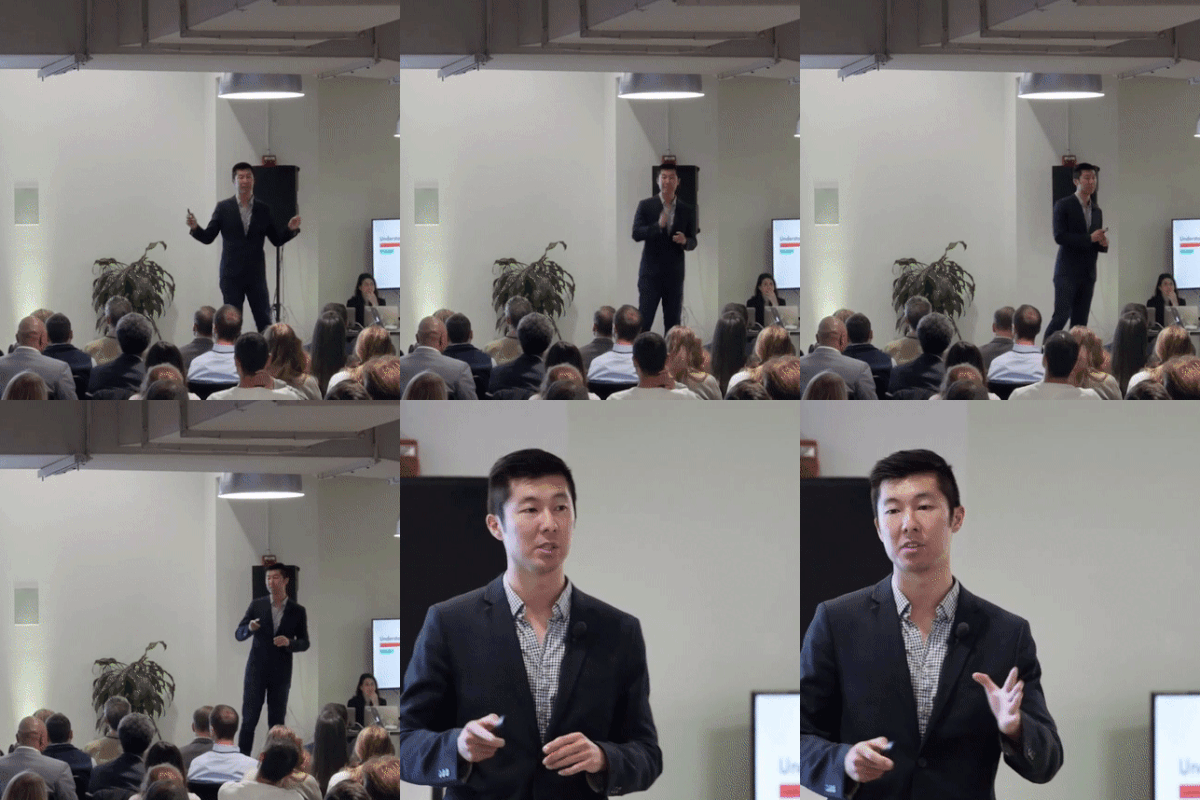
Dan Wu is our Lead Innovation Advisor focused on helping leaders build safe, high-growth products. As an SVP of Product & Chief Strategy Officer, he has led and managed products to achieve 6 to 8 figures in revenue. His work is informed by his background as a Harvard JD/PhD, where he focused on responsible innovation, social networks, and mixed-methods research.


 Made with Bullet